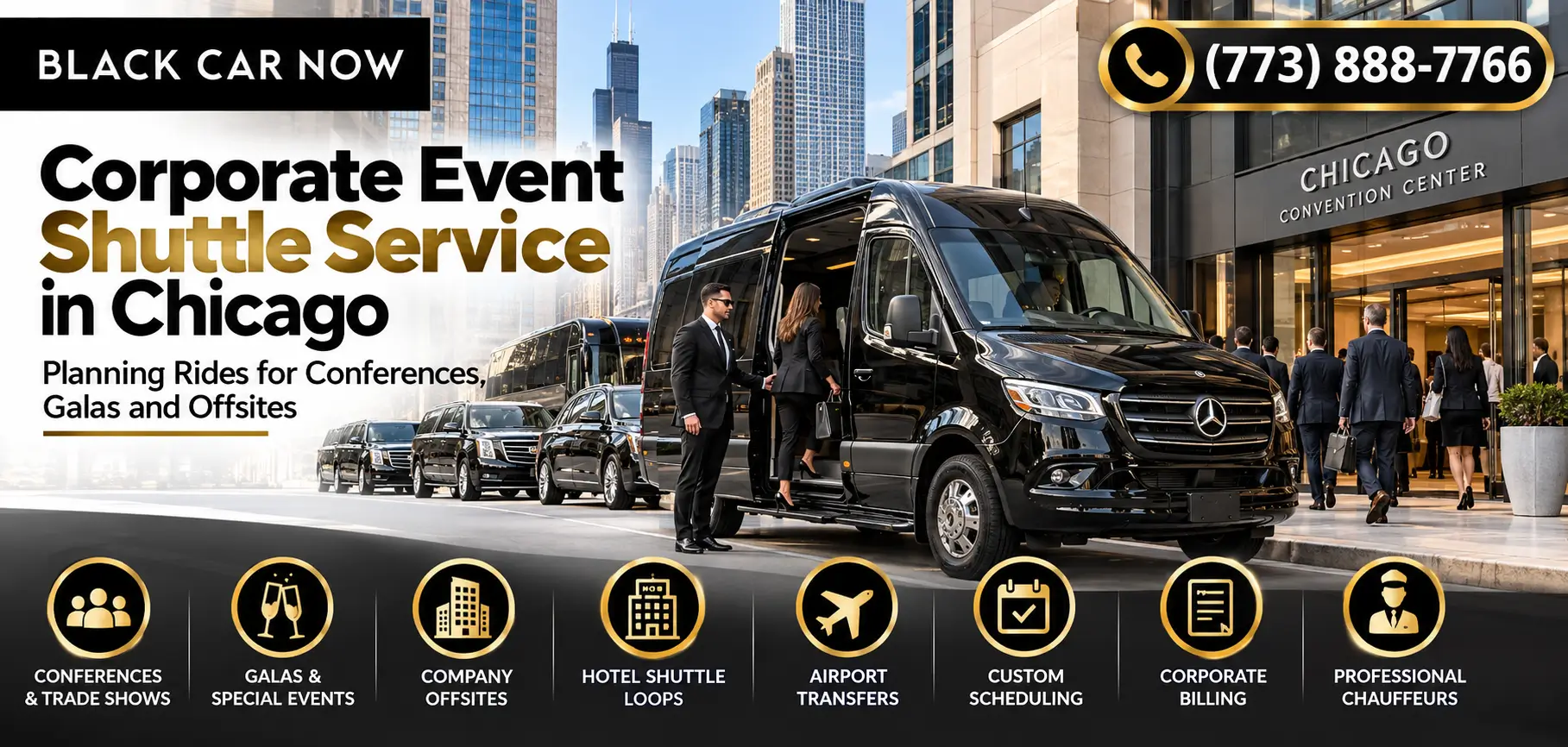
Quick answer: A successful corporate event shuttle service in Chicago starts with an accurate passenger count, suitable vehicle capacities, planned pickup locations and a realistic schedule. Conferences may need repeated hotel-to-venue loops, while galas and offsites often require coordinated arrival windows and return transportation. Event planners should account for luggage, accessibility, traffic, loading restrictions and peak departure times when choosing vehicles. Assigning an on-site transportation coordinator and confirming billing arrangements before the event can help reduce delays, confusion and unexpected costs.
Corporate events involve more moving parts than simply getting guests from one address to another. Conferences, executive meetings, galas and company offsites may require transportation for attendees arriving at different times, staying at multiple hotels or traveling between several venues.
In Chicago, event transportation also needs to account for traffic, downtown loading restrictions, convention schedules, hotel entrances and busy streets around popular venues. A shuttle plan that looks simple on paper can quickly become difficult if passenger demand, vehicle capacity and pickup timing are not coordinated.
Choosing the right corporate event shuttle service Chicago planners can rely on means organizing the entire transportation process, from the first arrival to the final return trip. This guide explains how to estimate vehicle requirements, organize hotel shuttle loops, establish pickup and staging locations, coordinate staff and manage invoicing.
For corporate transportation planning, explore Black Car Now’s Chicago corporate limo service to discuss transportation options for your next event.
Why Corporate Event Shuttle Planning Matters
When attendees arrive late or cannot identify their pickup location, the disruption can affect registration, meetings, dinner reservations and the overall event schedule. A coordinated transportation plan gives guests clear instructions and helps organizers manage arrival and departure periods.
- Predictable arrivals: Schedule transportation around registration times, keynote sessions and event start times.
- Coordinated group travel: Move attendees between hotels, conference venues, restaurants and offsite locations.
- Less confusion: Communicate the correct pickup point, vehicle identification and departure time.
- Better use of vehicles: Match passenger demand to vehicle capacity and the number of trips required.
- Clear accountability: Give drivers, event staff and planners a shared transportation schedule.
The best plan is not necessarily the one with the largest vehicles or the fewest trips. It is the one that meets the event’s timing, capacity, comfort and budget requirements without relying on unrealistic turnaround assumptions.
How to Calculate Headcount and Vehicle Requirements
Begin with the number of people who need transportation, not the total number of event invitations. Registration counts, hotel rooming lists and confirmed attendance can help establish a more accurate estimate.
Next, divide passengers into groups based on their travel needs. Some attendees may need airport transfers, others may use hotel shuttles, and executives or VIP guests may require individual transportation.
Use Practical Passenger Capacity
Vehicle selection should be based on the actual passenger capacity of the specific vehicle, not an assumption based on its general category. Allow for luggage, accessibility needs, comfort preferences and any restrictions that affect seating.
For preliminary planning, use this simple calculation:
Vehicles required for one departure = passengers traveling together ÷ usable passenger capacity, rounded up.
For example, if 86 attendees need to travel together and the selected vehicle accommodates 20 passengers, you would need five vehicles for that departure if all 86 people must travel at the same time. If the event permits multiple trips, the number of vehicles may be lower, but the schedule must allow enough time to transport everyone.
This is an illustrative calculation, not a vehicle recommendation. Confirm passenger capacity, luggage allowance and accessibility arrangements with the transportation provider.
| Planning Factor | What to Calculate | Why It Matters |
|---|---|---|
| Total headcount | Confirmed attendees needing transportation | Establishes the overall passenger demand |
| Peak departure demand | Passengers who must arrive within the same time window | Determines how many vehicles may be needed simultaneously |
| Usable vehicle capacity | Confirmed passenger capacity for the selected vehicle | Prevents overbooking and uncomfortable loading |
| Trip turnaround | Travel, unloading, return travel and reloading time | Shows whether repeated trips can meet the schedule |
| Special requirements | Luggage, mobility needs and executive transport requests | Helps select suitable vehicles and pickup arrangements |
Choosing the Right Vehicle Mix for Corporate Events
Different events require different transportation arrangements. A large conference may benefit from a shuttle fleet operating on a repeating schedule, while a leadership offsite may need a combination of group transportation and individual executive transfers.
| Event Type | Typical Transportation Need | Planning Priority |
|---|---|---|
| Conference | Repeated transfers between hotels and the venue | Peak arrival windows and shuttle frequency |
| Corporate gala | Scheduled arrivals and coordinated return trips | Venue access, guest experience and departure queues |
| Executive offsite | Group transfers, smaller groups or individual executive rides | Privacy, flexibility and precise scheduling |
| Multi-day convention | Daily hotel, venue, dinner and networking transfers | Consistent schedules and changing passenger demand |
Ask the provider to recommend vehicles based on your actual itinerary and passenger requirements. Confirm the number of vehicles, capacity, accessibility options, luggage arrangements and whether the fleet can support simultaneous departures.
Planning Hotel Shuttle Loops in Chicago
Hotel shuttle loops are useful when attendees are staying at one or more hotels and need transportation to a shared conference or event venue. Rather than assigning every guest an individual pickup, the planner establishes a repeating service with defined stops and departure times.
Build a Realistic Loop
Start by listing every hotel, the event venue, passenger demand and required arrival time. Then determine whether one route can serve the hotels efficiently or whether separate routes would reduce travel time.
A loop should account for more than driving distance. Time is also needed for traffic, turning movements, passenger loading, unloading and any venue access procedures.
Estimate the Full Turnaround Time
Use the following planning model:
Loop duration = outbound travel + stop and loading time + return travel + operational buffer.
For instance, a route with 25 minutes of outbound driving, 10 minutes for loading and unloading, 25 minutes of return driving and a 10-minute buffer would take about 70 minutes. This is only an example; actual times should be based on the route, event date and operating conditions.
If attendees must arrive before a keynote or registration deadline, avoid scheduling the final shuttle to arrive at the exact start time. Allow time for unloading, walking to the entrance and unexpected delays.
Use Different Schedules for Different Demand Periods
Morning conference arrivals may require frequent service, while mid-afternoon demand could be lighter. Gala departures may have a sharp peak when the event ends. The transportation plan should reflect these differences instead of using one frequency throughout the day.
Pickup Points, Staging Areas and Venue Access
A vehicle can arrive on time and still create a delay if the pickup point is unclear or the venue cannot accommodate loading. Chicago event planners should confirm the exact location where vehicles can legally and safely stop.
For each pickup location, record:
- Exact address and entrance: provide the correct hotel entrance, loading zone or designated curbside point.
- Passenger instructions: explain where guests should wait and when they should be ready.
- Loading restrictions: confirm any time limits, access rules, permits or restrictions that apply.
- Vehicle staging: identify where vehicles can wait between trips without obstructing traffic.
- Venue contact: confirm who can resolve access questions on event day.
- Backup arrangement: establish an alternative meeting point if the primary pickup location becomes unavailable.
Do not assume a large vehicle can wait directly outside every downtown venue. Check loading access and staging arrangements with the venue, hotel and transportation provider in advance.
The Role of an On-Site Transportation Coordinator
For events with multiple vehicles, hotel stops or tightly timed departures, a dedicated transportation coordinator can help keep the operation organized. This person acts as the communication link between the event planner, drivers, venue staff and attendees.
Before the Event
- Confirm the final itinerary and vehicle assignments.
- Share driver contact procedures and the event-day escalation plan.
- Verify pickup points, access permissions and staging locations.
- Review passenger counts and special transportation requirements.
During the Event
- Monitor arrivals, departures and shuttle turnaround times.
- Communicate delays and revised pickup instructions.
- Help guests identify the correct vehicle and boarding point.
- Coordinate with venue staff if access or loading conditions change.
- Escalate issues to the transportation provider and event lead.
One clearly identified point of contact reduces the risk of drivers receiving conflicting instructions from several people. For larger programs, clarify whether the coordinator is supplied by the transportation company or needs to be assigned by the event organizer.
Corporate Event Shuttle Service Cost and Invoicing
Transportation costs depend on the fleet, service duration, number of vehicles, itinerary, operating hours and booking terms. A short transfer and a multi-hour shuttle program should not be compared as if they were the same service.
When requesting a quote, give the provider a detailed itinerary and ask for the pricing structure in writing.
| Cost Factor | What Can Affect the Price? | What to Confirm |
|---|---|---|
| Vehicle type and quantity | Passenger capacity, vehicle category and simultaneous service requirements | Vehicle assignments and quoted rates |
| Service duration | Operating hours, waiting time and schedule extensions | Minimum hours and overtime policy |
| Route complexity | Multiple stops, distance, traffic and turnaround time | Included mileage, routing assumptions and additional charges |
| Event timing | Early starts, late finishes and changes to the itinerary | Availability and charges for schedule changes |
| Billing arrangements | Centralized billing, deposits, payment terms and approved extras | Invoice format, payment deadline and authorization process |
Make Invoicing Easy for Your Finance Team
Corporate events may involve a planner, finance department, executive assistant and multiple internal cost centers. Agree on billing arrangements before the event to prevent confusion after the rides are completed.
- Identify the company or department responsible for payment.
- Confirm whether a deposit or prepayment is required.
- Specify the purchase order or billing reference if applicable.
- Clarify how extra waiting time, added stops and schedule changes are approved.
- Request an itemized invoice showing the agreed services and authorized extras.
- Establish who can approve additional charges during the event.
A written quote and a clearly documented change-approval process make it easier to reconcile the final invoice with the original transportation plan.
Common Mistakes Event Planners Should Avoid
Even a well-organized event can experience transportation problems if the itinerary does not reflect actual operating conditions. Avoid these common planning mistakes:
- Using total attendance instead of peak demand: identify how many guests need rides at the same time.
- Choosing vehicles by capacity alone: consider luggage, accessibility and the full passenger experience.
- Underestimating turnaround time: include loading, unloading, return travel and a reasonable buffer.
- Leaving pickup points vague: share exact addresses, entrances and meeting instructions.
- Ignoring venue restrictions: confirm staging and loading arrangements before vehicles arrive.
- Failing to assign a coordinator: make sure one person can manage operational questions.
- Overlooking late-night departures: plan the return service around the actual event ending and guest demand.
- Leaving billing until the end: confirm payment terms and approval procedures in advance.
Corporate Event Transportation Planning Checklist
Use this checklist when preparing a shuttle request or transportation brief.
- Confirm event dates, service hours and all addresses.
- Estimate passenger numbers by pickup point and departure window.
- Identify vehicle capacity, luggage and accessibility requirements.
- Prepare a route plan and realistic shuttle turnaround schedule.
- Confirm pickup locations, loading permissions and staging areas.
- Assign an event-day transportation coordinator.
- Share guest instructions and driver communication procedures.
- Establish contingency arrangements for delays or access changes.
- Confirm pricing, deposits, overtime and invoicing terms.
- Distribute the final itinerary to everyone who needs it.
Frequently Asked Questions
Plan Corporate Event Transportation with Black Car Now
Corporate shuttle planning works best when passenger counts, vehicle selection, routes, pickup locations and billing are coordinated before event day. A clear itinerary and designated point of contact can help keep transportation organized for conferences, galas, executive meetings and company offsites.
Black Car Now provides corporate transportation options for Chicago-area travel. Explore our Chicago corporate limo service to discuss your event’s transportation requirements.
Prepare your event date, locations, passenger estimates and preferred service windows before requesting a quote. Sharing those details early helps the transportation provider recommend an appropriate fleet and schedule.