Written by Sam Ali
Published: October 2, 2026
Read Time: 14 minutes
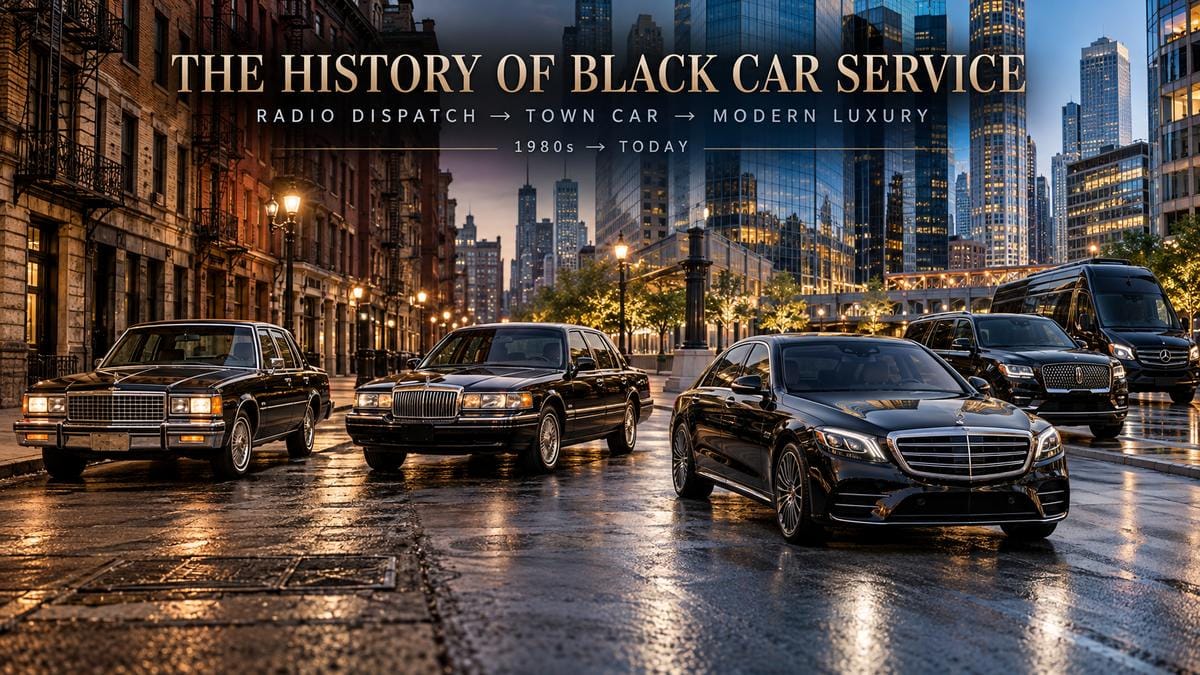
The history of black car service is much younger than the history of the limousine, but it tells an equally interesting transportation story. The recognizable black-car industry began taking shape in New York during the late 20th century, when radio-dispatched taxi operators, corporate accounts and prearranged transportation began evolving into a separate professional service.
What started with telephone bookings and two-way radios eventually became an industry associated with executive sedans, airport travel, Wall Street accounts and the Lincoln Town Car. Later came luxury SUVs, GPS, flight tracking, online reservations, smartphones and larger executive vehicles.
Today, the phrase “black car” describes much more than paint color.
Quick answer: The history of black car service as a distinct professional transportation category can be traced to New York’s radio-dispatch taxi industry of the 1960s and 1970s. A major turning point came in 1982, when radios began moving from medallion taxis into non-medallion vehicles. Many operators chose luxury black cars, helping create the modern black-car industry. Corporate transportation drove rapid growth during the 1980s, the Lincoln Town Car later became an industry icon, and today’s service has expanded to premium sedans, SUVs and group vehicles supported by digital dispatch and real-time travel technology.
Chauffeured Cars Existed Long Before “Black Car Service”
Professionally driven luxury transportation did not begin in the 1980s.
Chauffeurs had been driving wealthy families, business leaders, hotel guests and other private passengers since the early automobile era. Limousine companies and private-car operators existed for decades before anyone commonly described the business as “black car service.”
The newer term developed around a more specific business model.
Instead of a passenger standing at the curb and hailing a taxi, the ride was arranged in advance. A company or passenger contacted a dispatch operation, a car was assigned, and payment could be handled through a business account rather than directly in cash.
That distinction—prearranged transportation instead of street hail—became fundamental.
It remains important today. New York City’s Taxi and Limousine Commission still distinguishes Black Cars from street-hail taxis and other categories of for-hire transportation.
How the History of Black Car Service Began With Two-Way Radios
The roots reach back to the mid-1960s, when some New York taxi owner-drivers began forming radio associations.
Before smartphones, apps, GPS and text messages, a two-way radio was powerful technology.
Customers could telephone a dispatch office and request a car. The dispatcher could then contact drivers by radio and send one to the passenger.
Businesses also began maintaining accounts with these radio groups, giving employees a way to arrange transportation without relying exclusively on finding an available taxi on the street.
The model grew.
Historical research on New York’s taxi industry records approximately 1,700 radio-equipped cabs in 1973 and about 3,200 spread across 13 radio associations by 1982.
That success would eventually create an unexpected problem.
Why Radio Taxis Became a Problem for Street Hails
A taxi could be physically empty while already committed to a customer who had called ahead.
To somebody standing on the curb, that was frustrating.
The passenger could see available-looking taxis passing by but could not hail them because the drivers were responding to radio calls.
New York had a limited number of medallion taxis, so the more time those cars spent handling prearranged radio work, the fewer were available to people trying to hail a cab.
Regulators eventually moved toward separating the two types of business.
Street-hail taxis would focus on the street.
Prearranged cars would handle dispatched reservations.
That regulatory change helped create an entirely new transportation industry.
1982: The Turning Point
In March 1982, the first radio systems were transferred from medallion taxis to non-medallion cars within two companies, Intaboro and Dial. The broader transition continued over the following several years and was completed by March 1987.
Something important happened when owner-drivers moved into the new non-medallion radio cars:
Many selected luxury black automobiles.
Those vehicles no longer needed to look like traditional yellow taxis because they were not depending on passengers recognizing them for a street hail.
The customer had already reserved the car.
The dispatcher already knew which vehicle was being sent.
The driver already knew where the passenger was waiting.
The vehicle could therefore be discreet rather than visually advertising itself as a taxi.
That combination of prearranged dispatch + business accounts + luxury black vehicles helped define the emerging black-car industry.
Why Were the Cars Black?
Black was a natural fit for professional transportation.
It is formal, understated and works equally well for a corporate office, hotel entrance, airport terminal or evening event. Unlike brightly colored taxis, the vehicle did not need to attract passengers from the street.
The reservation already existed.
Black also complemented the luxury sedans commonly chosen by operators. A polished black executive sedan could provide the professional image corporate clients expected while remaining discreet enough for everyday business transportation.
Eventually the color became so closely associated with the service that it helped name the entire category.
But the meaning became broader than paint.
A modern black car is defined much more by the way transportation is arranged and delivered than by the literal color of the automobile.
Corporate Accounts Drove the 1980s Boom
The growth of corporate America in the 1980s created ideal conditions for black-car companies.
Financial institutions, advertising firms, law offices, media companies and other businesses needed reliable transportation for employees and clients.
A secretary working late might need transportation home.
An executive could need a car to an airport.
A client arriving at a Manhattan office could be collected by a professional driver.
An employee could use a company transportation account without having to pay a taxi fare personally and seek reimbursement later.
By 1989, contemporary reporting described nearly 12,000 black cars serving corporate customers in New York and an industry that had experienced roughly six years of rapid growth.
Black-car transportation was no longer an obscure alternative to taxis.
It had become part of professional business life.
The Difference Between a Black Car, Taxi and Limousine
The categories can sound interchangeable today, but historically they developed differently.
A traditional taxi was built around immediate public availability and street hails.
Black-car service became associated with prearranged dispatched transportation, particularly corporate-account work.
Luxury limousine companies offered another form of prearranged premium transportation, historically associated with chauffeur-driven luxury cars, formal vehicles and later stretch limousines.
New York City’s current regulations still recognize separate categories for Community Cars, Black Cars and Luxury Limousines, even though the vehicles passengers see on the street can sometimes appear similar.
For passengers outside New York, the everyday terminology has become less rigid. “Black car,” “executive car,” “chauffeur service” and “limo service” can overlap depending on the market and company.
The Lincoln Town Car Era in the History of Black Car Service
Few vehicles became as closely identified with professional car service as the Lincoln Town Car.
For years, a clean black Town Car represented the executive sedan.
Its styling was formal without being flashy. Rear-seat space made it comfortable for chauffeured passengers. A large trunk suited airport luggage. The traditional sedan shape looked appropriate outside a corporate headquarters, hotel or terminal.
It also offered something essential to the black-car business:
consistency.
Corporate travel managers and frequent travelers could reserve a sedan in different cities and generally understand what type of transportation to expect.
The vehicle became part of the service standard.
During the Town Car era, travelers often did not ask for an exotic luxury model. They wanted a professional sedan, a qualified driver and predictable service.
That combination became a foundation of the modern Chicago black car service.
Why Executive Sedans Became So Important
The black-car passenger did not necessarily want attention.
That is one of the biggest differences between executive black-car transportation and the popular image of a stretch limousine.
A corporate traveler might value:
quietness, rear-seat comfort, professional appearance, privacy and punctuality.
A senior executive arriving at a financial office did not necessarily need a vehicle that announced the arrival to everyone on the block.
The executive sedan provided luxury without spectacle.
That made vehicles such as the Lincoln Town Car, and later premium Mercedes-Benz, BMW and Cadillac sedans, natural successors in the industry.
Today’s executive car service in Chicago continues that philosophy with newer vehicle technology and more refined cabins.
Airport Transportation Became a Core Black-Car Market
Airports and black-car service fit naturally together.
The passenger knows the flight in advance.
The pickup is scheduled.
There is a defined origin or destination.
Luggage matters.
Timing matters.
Reliability matters.
Business travelers also frequently need transportation between airports, downtown offices, hotels and suburban corporate locations.
As commercial air travel expanded, airport transportation became one of the most important uses for professional sedans and later SUVs.
Modern Chicago airport limo and black car service adds technology that operators in the 1980s could only have imagined, including live flight monitoring and real-time schedule coordination.
But the basic service remains recognizable: the traveler reserves transportation before reaching the curb.
Corporate Transportation Became More Organized
Black-car companies also moved beyond isolated reservations.
Corporate clients needed account management, recurring rides, visiting-executive transportation, conference schedules and multiple vehicles.
That led to transportation becoming more coordinated.
A company might need:
- Airport pickup for an executive
- Hotel transfer for a visiting client
- Several meetings across downtown
- Transportation to a business dinner
- A return to the hotel or airport
Instead of treating those as unrelated rides, professional transportation companies could manage them as one itinerary.
That remains central to modern Chicago corporate limo service, where the transportation schedule can be built around the business day rather than one isolated trip.
Why the Lincoln Town Car Eventually Disappeared
Lincoln ended production of the Town Car after the 2011 model year.
That created a major transition for chauffeured transportation companies that had relied on the platform for years.
But passenger expectations were already changing.
Travelers wanted modern safety technology, contemporary interiors, improved connectivity and newer styling. Families and executive teams were traveling with more luggage. Premium SUVs were becoming more accepted for professional transportation.
The industry had to move forward.
What followed was not the end of black-car service.
It was the beginning of a more diverse fleet era.
Mercedes-Benz, BMW and Cadillac Raised the Sedan Standard
Luxury sedans became more technologically sophisticated.
Mercedes-Benz S-Class models offered increasingly advanced rear-seat comfort, ride quality and cabin technology. BMW’s 7 Series developed its own executive identity. Cadillac continued serving travelers who preferred American luxury.
These vehicles shifted the perception of executive car service.
The professional sedan was no longer expected simply to be clean, large and black.
Passengers increasingly expected:
advanced climate control, quieter interiors, better suspension, charging capability, sophisticated safety systems and a high-quality rear cabin.
A modern Mercedes-Benz S-Class chauffeur experience shows how far the executive sedan has evolved from the radio-dispatched cars of the 1980s.
The Luxury SUV Changed Black Car Transportation
Perhaps the biggest vehicle change after the Town Car was the rise of the luxury SUV.
The Cadillac Escalade, Lincoln Navigator, GMC Yukon XL and similar vehicles solved problems that executive sedans could not always solve easily.
They offered more space for luggage.
They could accommodate additional passengers.
They provided easier group airport travel.
Their tall cabins and commanding presence also appealed to VIP and executive travelers.
Most importantly, the SUV could remain professional.
A polished black Navigator or full-size premium SUV could arrive at a corporate office or luxury hotel without looking like a recreational family vehicle.
That helped the SUV become one of the defining vehicles of modern chauffeured transportation.
Modern Black-Car Fleets Are No Longer One-Model Fleets
Today’s traveler may need a different vehicle depending on the assignment.
A solo executive can prefer an S-Class or BMW 7 Series.
A family arriving at O’Hare with luggage may need a full-size SUV.
Several executives sharing an itinerary may benefit from a Navigator or Yukon XL.
A larger group may need a Sprinter.
The current black car fleet reflects that evolution with executive sedans, Lincoln Navigator, GMC Yukon and Denali models, Mercedes-Benz S-Class, BMW 7 Series and larger group options.
The black-car concept has expanded beyond a single sedan while preserving the same basic purpose: private, prearranged professional transportation.
How Technology Changed the History of Black Car Service
Technology has transformed almost every part of the reservation.
The earliest radio-service passenger called a dispatch office.
The dispatcher communicated with the driver through a two-way radio.
There was no GPS location dot.
No automatic flight alert.
No text message showing that the vehicle had arrived.
No online reservation form.
No digital itinerary.
Modern dispatch systems can coordinate vehicles, monitor flight schedules, track timing, communicate with chauffeurs and maintain detailed reservations in ways earlier operators could not.
Yet the fundamental workflow remains remarkably familiar:
Passenger reserves → dispatcher coordinates → vehicle arrives → chauffeur completes the trip.
Technology changed how quickly and precisely those steps happen.
It did not eliminate them.
Smartphones Changed Passenger Expectations
The smartphone introduced another major shift.
Travelers became accustomed to seeing transportation information immediately. They could check flights, maps, traffic and reservations from a device in their hand.
That raised expectations for traditional transportation companies too.
Passengers increasingly expected confirmation, communication and accurate pickup information before stepping outside.
Professional car services responded by combining old-school reservation management with new digital tools.
The result is a modern system that can provide the convenience of digital communication while preserving the planned nature of professional transportation.
Prearranged Transportation Still Matters
One of the most interesting things about black-car history is how much the original concept remains intact.
The early radio car was valuable because the passenger did not have to hope an empty taxi happened to pass by.
The transportation had already been arranged.
That same principle remains useful today.
With point-to-point car service, the pickup location, destination and schedule are established before the journey begins.
For more complicated days, hourly transportation keeps a vehicle and chauffeur attached to an itinerary for a defined period.
The technology is different.
The value of planning ahead is not.
The Chauffeur Remains Central
Cars receive much of the attention, but the professional driver has always been essential.
A modern luxury sedan without professional service is simply a luxury automobile.
Chauffeured transportation adds schedule management, discretion, local driving knowledge, passenger assistance and accountability to the vehicle itself.
That is why professional chauffeur service remains distinct from simply renting an expensive car.
The passenger is not paying only for leather seats or a luxury badge.
The passenger is paying to have transportation handled.
Chicago Developed Its Own Black-Car Culture
The industry may have developed its recognizable black-car identity in New York, but the business model naturally fit Chicago.
Chicago has the ingredients that make prearranged professional transportation useful:
two major commercial airports, large downtown business districts, luxury hotels, convention traffic, corporate headquarters, major restaurants, suburban business corridors and private aviation facilities.
O’Hare alone creates constant movement between the airport and Downtown Chicago, Rosemont, Oak Brook, Schaumburg, Naperville, the North Shore and other business destinations.
The Loop, West Loop, River North, Gold Coast and Streeterville generate another layer of executive and hospitality travel.
That environment helped make luxury black car transportation in Chicago relevant far beyond the traditional image of a chauffeured executive sedan.
A Short Black Car Service Timeline
The industry’s evolution can be seen through several major periods:
- Mid-1960s: New York taxi owner-drivers begin organizing radio associations and handling telephone-prearranged rides.
- 1970s: Radio-dispatched trips and business transportation accounts expand.
- 1982: The first radios begin moving from medallion taxis into non-medallion vehicles, helping establish the modern black-car category.
- Mid-to-late 1980s: Corporate demand drives rapid black-car growth.
- Early 1990s: Thousands of black cars operate through dozens of New York bases.
- 1990s–2000s: The Lincoln Town Car becomes one of the defining executive transportation vehicles.
- 2010s: Luxury SUVs become increasingly important as the Town Car era ends and traveler expectations change.
- Today: S-Class sedans, premium SUVs, Sprinters, digital dispatch, GPS and flight-aware scheduling shape modern professional car service.
The timeline shows that the industry’s defining feature was never just the shape of one automobile.
It was the combination of advance reservation, professional coordination and a vehicle suited to the passenger’s needs.
What Does “Black Car Service” Mean Today?
Today the term is broader than its New York regulatory origin.
In some places, “black car” is used loosely to describe premium prearranged transportation in luxury sedans or SUVs.
In New York City, however, Black Cars remain a formally recognized for-hire category. TLC describes black-car bases as central dispatch facilities handling prearranged trips, with most business paid through methods other than direct cash payment to the passenger’s driver.
That distinction is useful because it reminds us where the modern idea came from.
Black-car service was built around reservation and dispatch, not around cruising the street looking for passengers.
Is Every Black Luxury Vehicle a Black Car Service?
No.
A vehicle’s color does not create the service.
Someone can own a black Mercedes-Benz or Cadillac and use it as a personal car.
Likewise, professional chauffeured transportation can sometimes use a vehicle that is not literally black.
The service model matters more:
The trip is arranged in advance. The passenger knows who is responsible for the transportation. A professional vehicle is assigned. Timing and destination details are coordinated.
That is why the phrase has survived even as the fleet expanded beyond the classic black sedan.
Why Black Car Service Still Appeals to Business Travelers
Business travelers often value predictability more than novelty.
They want to know that the car is reserved.
They want enough room for luggage.
They want a professional pickup.
They want the vehicle to fit the image of the meeting, hotel or client they are visiting.
And they want transportation to happen without consuming attention that should be spent on the workday.
Those priorities are remarkably similar to the needs that helped drive corporate black-car growth during the 1980s.
The tools improved.
The vehicles improved.
The business need remained.
Frequently Asked Questions
When did black car service begin?
The modern black-car industry developed from New York’s radio-dispatch transportation business and became a distinct category during the early 1980s.
Was black car service invented by one person?
No single person is generally credited with inventing the industry. It developed through taxi radio associations, owner-drivers, dispatch bases, corporate customers and regulatory changes.
Why are black cars traditionally black?
Black vehicles provided a formal, discreet appearance suitable for corporate and professional transportation. Because reservations were prearranged, the cars did not need the highly visible color scheme used by street-hail taxis.
What vehicle became most associated with black car service?
The Lincoln Town Car became one of the most recognizable professional sedans in the American chauffeured transportation industry.
Why did SUVs become popular for black car transportation?
Luxury SUVs offer additional passenger and luggage space while maintaining a professional appearance, making them particularly useful for airport travel, executive groups and families.
Is black car service the same as limousine service?
The terms can overlap in everyday use, but they have different historical origins. Black-car service developed around prearranged dispatched transportation, while limousine service has a much older history connected with chauffeur-driven luxury automobiles.
Does a black car have to be a sedan?
No. Modern black-car fleets can include executive sedans, luxury SUVs and larger vehicles such as Sprinters.
How is black car service different from hailing a taxi?
Traditional black-car transportation is reserved in advance. Street-hail taxi service is designed for passengers who flag down an available vehicle from the curb.
Is black car service only for executives?
No. Although corporate transportation played an important role in the industry’s growth, modern black-car service is also used for airports, hotels, private travel, events, families and other prearranged trips.
Why the History of Black Car Service Still Matters
The history of black car service explains why today’s industry still emphasizes reservation, professionalism and discretion.
It began before apps, smartphones and GPS, when a telephone call and a two-way radio allowed a passenger to know that a car was coming.
The 1980s transformed that system into a major corporate transportation business. The Lincoln Town Car gave the industry an instantly recognizable vehicle. Luxury SUVs expanded what executive transportation could handle. Modern sedans, Sprinters and digital dispatch systems pushed the industry into another generation.
But the central idea survived every technological change:
Arrange the transportation before you need it, assign a professional vehicle and chauffeur, and make the journey predictable for the passenger.
For current availability or to arrange private transportation in Chicago, call (773) 888-7766 or contact the reservations team.
Black Car Now
6360 W Eddy St, Chicago, IL 60634
Phone: (773) 888-7766
Reservations: 24/7